Minor Arcana · Swords · King
King of Swords Tarot Card Meaning
Intellectual authority, ethical judgment, strategy, truth, law, disciplined communication, and responsibility for the consequences of a decision.
King of Swords
Read it at a glance
The King of Swords asks what the fairest decision would be if status and emotion could not alter the facts.
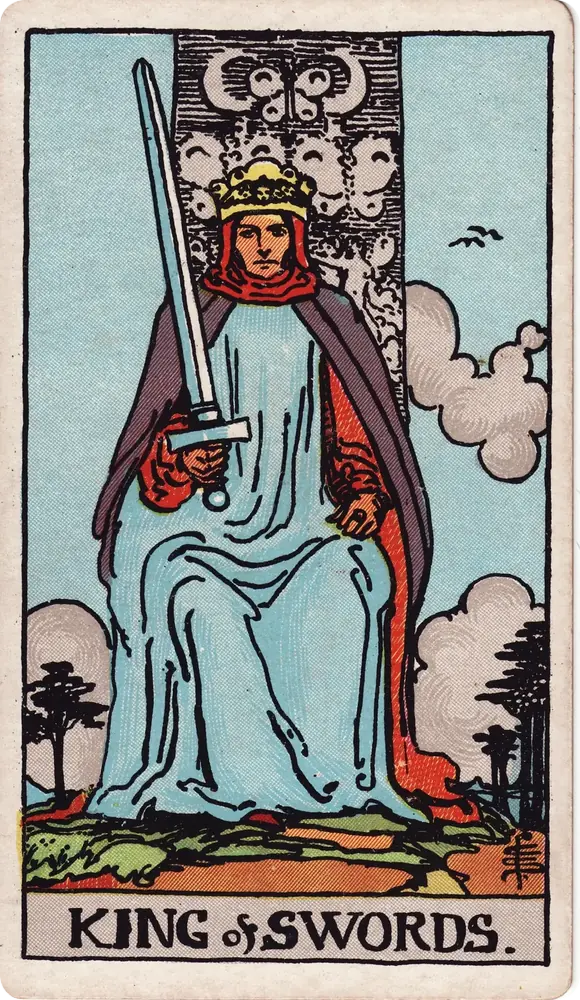
Explore crowns as symbols of authority and accountable leadership →The King of Swords sits upright on a carved throne holding a raised sword while the sky behind him is relatively clear. He represents mature command of the suit of Air: intellectual authority, law, strategy, disciplined communication, and the responsibility to make decisions whose consequences extend beyond personal feeling.
The King of Swords Upright Meaning
Upright, the King of Swords represents rational leadership, ethical judgment, expertise, structure, and the ability to communicate a difficult decision with precision. He favors evidence, consistency, and standards that can be explained rather than authority based only on status.
The King’s strength is not emotionlessness. It is the capacity to keep emotion from privately changing rules that should apply fairly. Mature Air understands that logic without ethics can become an efficient instrument of harm.
The Symbols on the King of Swords Tarot Card
The frontal posture, upright sword, carved throne, and open sky show judgment made visible and accountable.
The raised sword
The King holds the blade upright but slightly angled, suggesting active judgment rather than static symbolism. Authority is being applied to a real situation.
The throne and crown
Butterfly and crescent motifs connect the throne with transformation, intellect, and cycles of perception. The crown indicates mastery while also making the King publicly responsible for his rulings.
The clear sky and distant trees
Clouds remain but do not obscure the whole sky. Thought has gained perspective, while the trees remind us that abstract decisions still affect living systems.
The King faces the reader directly, unlike the more lateral Queen. His decisions enter the public world as policy, verdict, strategy, or final instruction. The card asks whether authority can explain itself and withstand scrutiny.
Explore crowns as symbols of authority and accountable leadership →
The King of Swords in a Love Reading
In love, the King of Swords can indicate a serious, thoughtful, self-controlled partner who values honesty, compatibility, and clear agreements. Commitment may be expressed through decision, planning, and consistency more than overt sentiment.
The card can also show emotional distance, rigid expectations, or a relationship being evaluated almost entirely through logic. Healthy partnership requires that standards serve both people rather than becoming a courtroom in which one partner is always judge.
The King of Swords as Feelings or Intentions
As feelings, the King of Swords suggests respect, serious consideration, mental compatibility, and emotions held under disciplined control. Someone may feel more than they choose to display.
As intentions, he favors making a clear decision, defining terms, advising, protecting through structure, or communicating from a position of authority. He is unlikely to act without a rationale.
The King of Swords in Money and Career
For career, the King of Swords strongly supports law, policy, research, medicine, technology, consulting, leadership, education, strategy, and any role requiring objective decision-making. He can represent an expert, executive, attorney, or authoritative advisor.
For money, he favors contracts, tax or legal guidance, disciplined planning, risk analysis, and decisions that can be justified over the long term. Seek expertise where the rules are complex.
The King of Swords Reversed Meaning
Reversed, the King of Swords can indicate abuse of authority, manipulation, intimidation, rigid ideology, intellectual arrogance, or decisions presented as objective while serving private interests.
It can also show poor judgment, lack of expertise, or power without accountability. Require transparent reasoning, written terms, and appropriate review rather than being overawed by confidence or title.
The King of Swords as Advice
Use the standard you would defend publicly. Gather qualified evidence, make the decision proportionate to the facts, and communicate the reasoning clearly enough that others can evaluate it.
Is the King of Swords a Yes or No?
The King of Swords is a strong yes for legal, strategic, professional, and decision-based questions when the path is ethical, documented, and intellectually sound.
Continue with Queen of Swords, then explore the complete Swords suit guide and all tarot card meanings.
Virtual tarot readings · Wherever you are
Ready to see what the cards are saying to you?
Choose a live reading by Zoom, FaceTime, or phone—or select an email reading delivered privately to your inbox.Cancellation Policy
Please note that you may change or cancel your appointment at any time up to 24 hours ahead of your appointment time by clicking the link in your confirmation email. Cancellations made more than 24 hours ahead of your appointment time are 100% refunded.
If you wish to change your appointment less than 24 hours ahead of your time, please email info@tarot.nyc and we will assist you. Appointments canceled less than 24 hours ahead of your appointment time will receive a 50% refund.
There is no refund for missed appointments or no-shows.
Frequently Asked Questions About the King of Swords
What does the King of Swords mean as a person?
He may describe someone intelligent, authoritative, strategic, disciplined, ethical, reserved, legally minded, or overly rigid and controlling.
Does the King of Swords mean commitment?
He can indicate a serious and deliberate commitment, especially when expectations and terms are clearly understood.
What does the King of Swords mean for career?
It strongly supports leadership, law, policy, strategy, consulting, research, and decisions requiring expertise and impartial judgment.
What does the King of Swords reversed mean?
It can indicate abuse of power, manipulation, rigid thinking, intellectual arrogance, poor judgment, or authority without accountability.